
Plan for the next year



Written by: David Carneal – Digital Efficiency Consulting Group – DECG
Read Time: 3 min
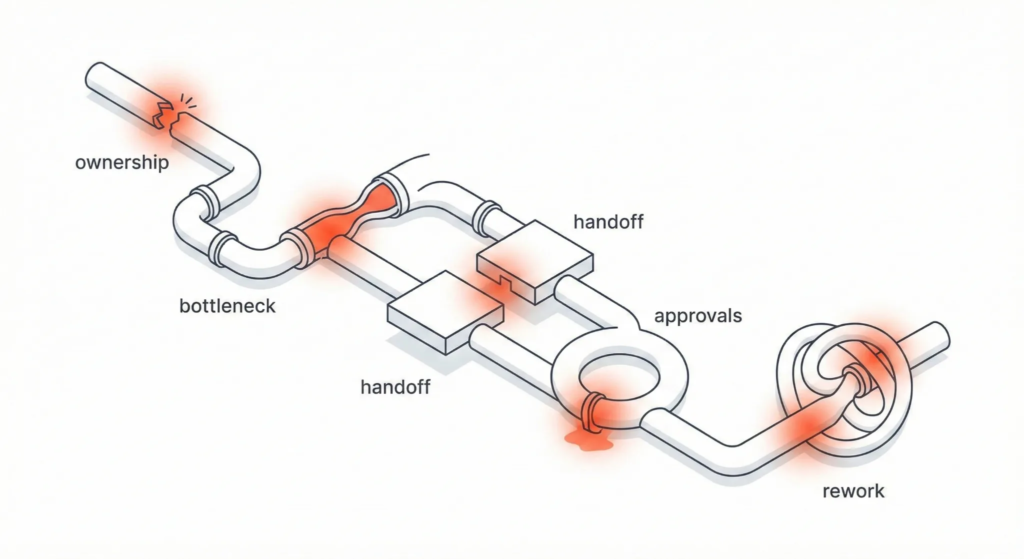
“Shared ownership” sounds collaborative. In practice, it often means work ricochets between teams until the deadline shows up and somebody takes an emergency bite out of it.
Ownership leaks are expensive because they create invisible delays. People spend time aligning, clarifying, and forwarding instead of finishing.
How to spot an ownership leak
If any of these feel familiar, you’ve got one:
- The outcome is important, but the owner is a group.
- Decisions require “alignment” across three teams.
- When something goes sideways, the first call is to a meeting.
The leader test (two questions)
Ask:
- Who owns the outcome (not the task list)?
- If this fails, who gets the first phone call?
If the answer is “we” or “the team,” that’s not ownership. That’s a fog machine.
Fix it with a single-threaded owner
A single-threaded owner is not a dictator. They’re the person responsible for:
- defining “done”
- making trade-offs visible
- escalating blockers quickly
- ensuring handoffs happen with the right context
Teams still do the work. The owner makes sure the work doesn’t bounce.
A practical ownership checklist
Use this to lock clarity in place:
- Outcome statement: “We will achieve X by date Y, measured by Z.”
- Decision rights: what can the owner decide without approval?
- Escalation rule: if blocked for more than 24-48 hours, who gets pulled in?
- Dependencies list: what other teams must deliver, and when?
- Definition of done: what “complete” means so rework doesn’t sneak in.
Common trap: RACI theater
RACI charts are fine, but they don’t replace ownership. If you need a spreadsheet to know who decides, the process is already too fragile.
Aim for one sentence you can say out loud:
- “Jordan owns the outcome. Dana approves budget changes. Everyone else supports.”
That’s it. Simple beats elaborate.
Quick win: the 10-minute ownership reset
In your next initiative kickoff:
- State the outcome in one sentence.
- Name the owner.
- Agree on one escalation rule.
- Write the definition of done.
You just saved future-you from a hundred “quick syncs.”
CTA: Run the leader test on your top three initiatives. If any outcome is “owned by a group,” assign a single-threaded owner and write a one-sentence definition of done. Clarity is the cheapest time you’ll ever buy.
Leave a Reply