
Plan for the next year


Written by: David Carneal – Digital Efficiency Consulting Group – DECG
Read Time: 3 min
Most strategies don’t fail in a dramatic explosion. They fail the way a shopping cart fails: one wobbly wheel, a squeaky hinge, and suddenly you’re steering with your whole body.
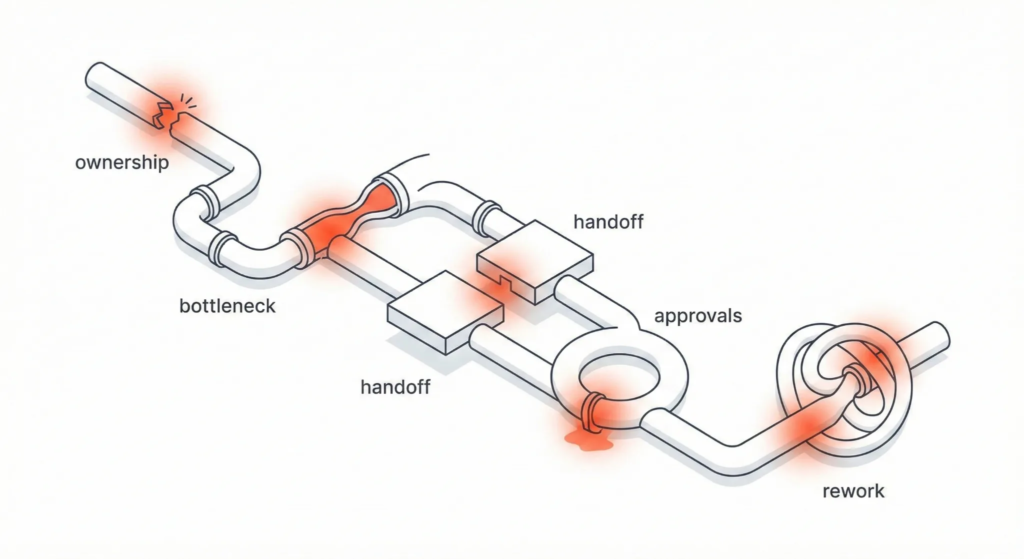
If you’re a department leader, you’ve seen it. The plan is solid. The deck is crisp. Then execution runs into the daily reality of unclear ownership, handoffs that leak context, approvals that take two weeks “for a quick sign-off,” and rework that shows up so often it gets treated like weather.
The inconvenient truth: you can’t launch cleanly on top of process clutter. If 2027 is your “launch year,” then 2026 has to be your “make-the-launch-possible” year.
What friction looks like in real life
Friction rarely shows up as one giant failure. It shows up as lots of small, repeatable slowdowns:
- A project is late, but only after the same handoff.
- Teams are busy, but output doesn’t move.
- Everybody has a different definition of “done.”
- Meetings multiply because the process can’t be trusted.
When effort is high and output is low, the gap is usually a system problem, not a people problem.
A quick “Where is it leaking?” self-audit
Pick one initiative that matters for next year. Then answer these quickly:
- Ownership: Who owns the outcome (not the task list)?
- Bottleneck: Where does work stack up the most?
- Handoffs: Where does responsibility transfer between teams?
- Approvals: Which steps require sign-off, and why?
- Rework: What gets redone most often?
- Meetings: Which recurring meetings exist because we don’t have clear rules?
If you can’t answer two or more without guessing, you just found the best place to start.
Three measurements that expose friction (fast)
You don’t need a six-month analytics project. Track these for two weeks on one workflow:
- Wait time: how long work sits between steps.
- Rework loops: how many times a deliverable bounces back.
- Decision latency: time from “question asked” to “decision made.”
These aren’t fancy. They’re brutally honest.
One small rule change that removes a lot of drag
Most friction comes from unclear rules. Pick one and tighten it:
- One definition of “done” (written, shared, used).
- One approval rule with clear decision rights.
- One handoff checklist so context doesn’t evaporate.
Rule clarity is cheaper than heroic effort, and it scales better.
Try this 72-hour experiment
In the next three days:
- Choose one deliverable that often gets reworked.
- Write a one-paragraph “done” definition.
- Share it with everyone who touches the work.
- Use it once. Then ask: what still caused confusion?
You’ll learn more from that than from a meeting about meetings.
CTA: If you want to pressure-test your execution runway, run the self-audit with your team on one launch-critical workflow. Identify the top two leaks, pick one rule to tighten, and measure wait time for two weeks. Momentum usually shows up right after clarity does.
Leave a Reply