
Plan for the next year


Written by: David Carneal – Digital Efficiency Consulting Group – DECG
Read Time: 3 min
If the phrase “process improvement” makes people brace for a multi-month initiative and a flood of meetings, good. That’s your early warning system.
A cleanup sprint is not a renovation. It’s a two-week, targeted fix to remove the friction that will otherwise sabotage next year’s launch.
The rule is simple: do one workflow, not ten. If you try to clean everything, you clean nothing.
Week 1: Find the top five time leaks
Start with a workflow that must function for 2027 to be real. For most teams, that’s something like order-to-cash, quote-to-ship, hiring-to-onboard, or support-ticket-to-resolution.
Do these four steps:
- Map the real process (not the process diagram).
- Include who touches it, where it waits, and where it loops.
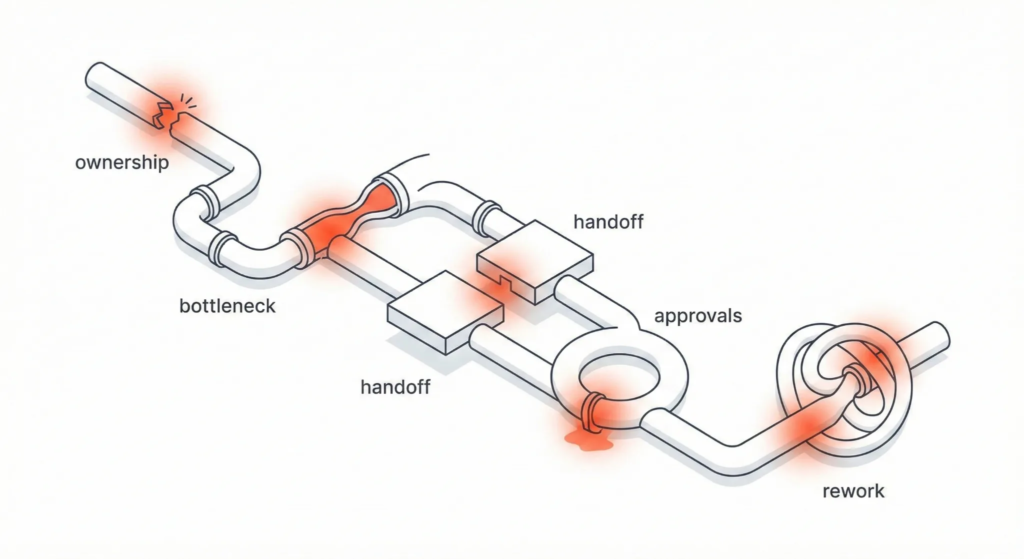
- Capture handoffs, approvals, rework, and the “we always have to ask Jim” moments.
2. Collect three inputs:
- Team feedback: where does it get stuck?
- Customer pain: where do they feel the seams?
- Where work sits: inboxes, queues, shared folders, “pending approval.”
3. Measure the boring stuff:
- Wait time per step
- Rework count per deliverable
- Decision latency (the time between “question asked” and “decision made”)
4. Rank the top five leaks by impact.
- Not by annoyance.
- By how much they slow the launch or create rework.
Week 2: Fix, lock in, make it stick
This week is about changing rules, not writing posters.
1. Assign single-threaded owners.
- One owner per fix.
- Not a committee. Not “shared.” One name.
2. Implement fixes as “rules of the road.” Examples:
- One definition of done.
- One handoff checklist.
- One approval rule with clear decision rights and a default path.
- One queue limit (WIP limit) to stop work from piling up.
3. Document in two minutes.
- If you can’t explain the fix in two minutes, it’s too complex for a sprint.
4. Close the loop.
- Two weeks later, review what improved, what didn’t, and adjust.
- Then repeat on the next workflow if needed.
A simple sprint agenda (so you don’t accidentally create meeting soup)
Keep it tight:
- Day 1: scope the workflow and define “done” for the sprint
- Day 2-3: map reality and collect pain points
- Day 4: identify leaks and pick top five
- Day 5: assign owners and draft fixes
- Week 2 Day 1-3: implement + train (short and practical)
- Week 2 Day 4: measure early results
- Week 2 Day 5: retro + lock the new standard
Why this works
Because it’s optimistic by design. You’re not asking people to try harder. You’re removing the friction that’s already frustrating them.
CTA: Want a guided version of this sprint that doesn’t derail operations? DECG can facilitate a cross-level working session (frontline through leadership) to identify the biggest time leaks, align owners, and launch the first two-week cleanup sprint with clear outputs.
Leave a Reply